Dominic Michel, Investment Director at Novastar Ventures, discusses Novastar Ventures’ Fund III investment in Sistema.bio, a pioneering company transforming farm waste into renewable energy and organic fertilizer.
What makes Sistema.bio stand out as a business and why did Novastar choose to invest in Sistema.bio at this stage in its journey?
Sistema.bio stands out because of its approach to addressing critical challenges faced by family farmers worldwide: access to affordable energy and sustainable agricultural inputs. Its innovative biodigester technology, financing and training empowers farmers to turn waste into renewable energy and organic fertilizer. This unlocks economic, health, and productivity benefits for farmers, building their resilience to climate change while reducing substantial greenhouse gas emissions.
We have been tracking Sistema.bio’s journey for some time and were impressed by the amazing value proposition that is being delivered to farmers and its proven ability to scale in multiple markets. Sistema.bio is now at a key inflection point as it seeks to deepen its impact in Africa and unlock carbon markets to accelerate growth and serve more farmers with the tools to build resilient, productive, and sustainable agricultural systems. For Novastar, it was an ideal time to step in and partner with a business that aligns so well with our mission.
Sistema.bio has recently formed strong and scalable partnerships with the likes of Nestlé, Danone and others that need Sistema.bio’s help to decarbonize their extensive food value chains. Sistema recently acquired Inclusive Energy, a pioneer in remote sensors for biogas and solar energy systems which will mean Sistema.bio will become the first global biogas platform capable of delivering carbon and methane reduction projects at scale with real time digital Monitoring, Reporting and Verification (dMRV). Lastly, Sistema.bio has successfully leveraged the carbon markets to reduce the price of its biodigester solution and reach more farmers, dramatically increasing the size of the addressible market.
What specific problem is Sistema.bio solving for family farmers in Africa, and why is this so important?
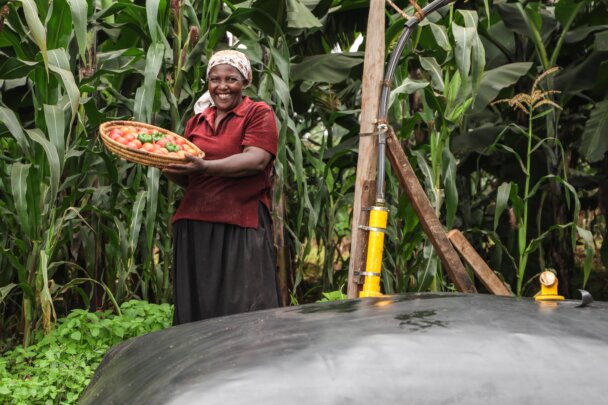
Some of the world’s hardest challenges — poverty, food security, and climate change — intersect at the 570m family farms around the world. These farmers face a number of challenges like unreliable access to affordable, clean energy, rising farm input costs and inefficient waste management. Sistema.bio’s innovative technology and financing empowers family farmers to transform farm waste into renewable energy and fertilizer. This unlocks economic, health, and productivity benefits for farmers, building their resilience to climate change while reducing substantial greenhouse gas emissions.
How does Sistema.bio’s mission align with Novastar’s?
At Novastar, we back transformative businesses where lasting benefits for people and planet naturally derive from the businesses’ growth and commercial success. Sistema.bio is a prime example of this — demonstrating how entrepreneurship and innovation can solve systemic problems while aligning economic, social and environmental incentives.
What is the size of the market opportunity for Sistema.bio in Africa, and how can this investment help it scale?
The smallholder farmer market in Africa has significant potential, driven by factors such as population growth, rising food demand, increasing investment in agritech, and climate-smart solutions. Agriculture contributes 23% of Sub-Saharan Africa’s GDP, with smallholder farmers playing a dominant role.
Currently, African countries are Sistema.bio’s second-largest market after India, accounting for 30–40% of its operations. To date, Sistema.bio has impacted over 80,000 farmers and installed over 14,000 digesters in the prominent markets of Kenya and Uganda. Since early 2023, Sistema.bio has also been operating in Zambia, Zimbabwe, Ghana, Malawi, Mozambique, and Tanzania through partnerships. Novastar’s investment will help scale operations into other countries, such as Morocco and Nigeria. The expansion plans for additional African countries include Niger, Burkina Faso, Mali, and Ivory Coast.
What lessons can Sistema.bio’s journey offer to other climate-tech entrepreneurs in Africa?
Sistema.bio’s growth to date demonstrates the unique opportunity to align the economic interests of a growing population in Africa with planet-positive technologies that shift the continent onto a low-carbon and climate resilient development trajectory. The economic habits of 1.4bn people are often overlooked as a lever to accelerate the low-carbon transition, but when access to solutions are provided affordably and reliably — as is the case with Sistema.bio — then the pace of adoption can be startling.